Sunday, November 11, 2018

Montag-10/15/18-Winds of Change-Scorpions

Monday was such a busy day, I had to break it into two posts.  In addition to all of the information we learned about the German school systems, we also had a full afternoon of cultural and historical learning events.  After lunch at the Hotel de Rome, we walked across town to the city center area.


We first visited the Berlin Memorial to the Murdered Jews of Europe.  This is a powerful memorial comprised of thousands of concrete slabs of differing heights called "stelae".  We each took some time to walk through on our own.  The memorial is constructed on a sloping field so that as you enter the memorial, soon you are consumed by the towering concrete which evokes a feeling of isolation and feeling trapped.  The stelae are constructed in orderly rows that are slightly askew.  This is intended to represent an orderly system that lost touch with human reason.  Though the designer denies the connection, one can't help but feel that you're walking through an endless dark cemetery.  I found the memorial powerful and thought provoking and I enjoyed how the abstract nature of the memorial allowed for varying interpretations.

We next rendezvoused in the square near Brandenburg Gate where we connected with Arvid, our outstanding tour guide.  Arvid provided historical background for all of the buildings in the square and how they evolved from WWII to the Cold War and Berlin Wall era, to the fall of the Berlin Wall and the modern era.  It was fascinating to see pictures of the no man's land around the wall on the East side.  As we stood on bricks that symbolized the former wall, Arvid told us about the day he and his wife joined the celebrating at the fall of the wall in November of 1989.  They climbed over and ventured a few hundred meters into East Berlin before running back, still fearful that the reunification was only temporary and they could be trapped on the other side like so many others in 1961.

We walked through the Memorial to the Sinti and Roma Victims of National Socialism in the Tiergarten park.  This was a powerful memorial with a deep, dark pool of water at the center.  In the center of the pool is a triangle shape to represent the badges worn by prisoners of concentration camps.  Around the edges of the pool are scattered stones, some with names of concentration camps.  There was a powerful moment when Arvid told us the story of his wife's great uncle who had been imprisoned at Mauthausen.  It was also in this place that we learned about the Stolperstein, or "stumbling blocks".  These are brass plates that have been placed at Holocaust victims' homes and workplaces to honor their last free choice before they became persecuted by the Nazis.  Once we learned about them, we noticed them on all of our walks throughout Germany.  Some have criticized the fact that they are in the ground, while others say it is a sign of respect that one must bow their head to read the inscriptions.
Reichstag Dome
We made our way through security and then toured the impressive Reichstag Dome.  The Reichstag is home to the German parliament.  The building was destroyed before WWII and went unused until after Germany was reunified.  The design of the dome is intended to symbolize a reunified Germany.  The transparent design is striking, but I found the details and symbolism incorporated into the design  fascinating.  The mirrored cone at the center of the dome reflects down on the Bundestag, or debating room of parliament, bringing a purposeful feeling of transparency in government. Around the dome are two walkways that are open to the public everyday.  The design of having the public walk above the government building was intentional symbolizing that the people are above the government.

The designs were also environmentally conscious.  The mirrors reflect natural light into the large room below, reducing the energy required to light the building.  A sun shield tracks the rotation of the sun preventing the natural light from becoming too blinding in the room below.  The open air platform at the top of the dome catches water that is reused and allows for beautiful 360 degree views of Berlin.  We were fortunate to catch the sun setting while atop the platform.

We wrapped up our tour and headed for a true German dinner at Clarchens Ballhaus where we enjoyed sausages, sauerkraut, weiner schnitzel, and potato salad.

Members of our group in the Reichstag Dome

Montag-10/15/18-Me and Julio Down by the Schoolyard-Paul Simon

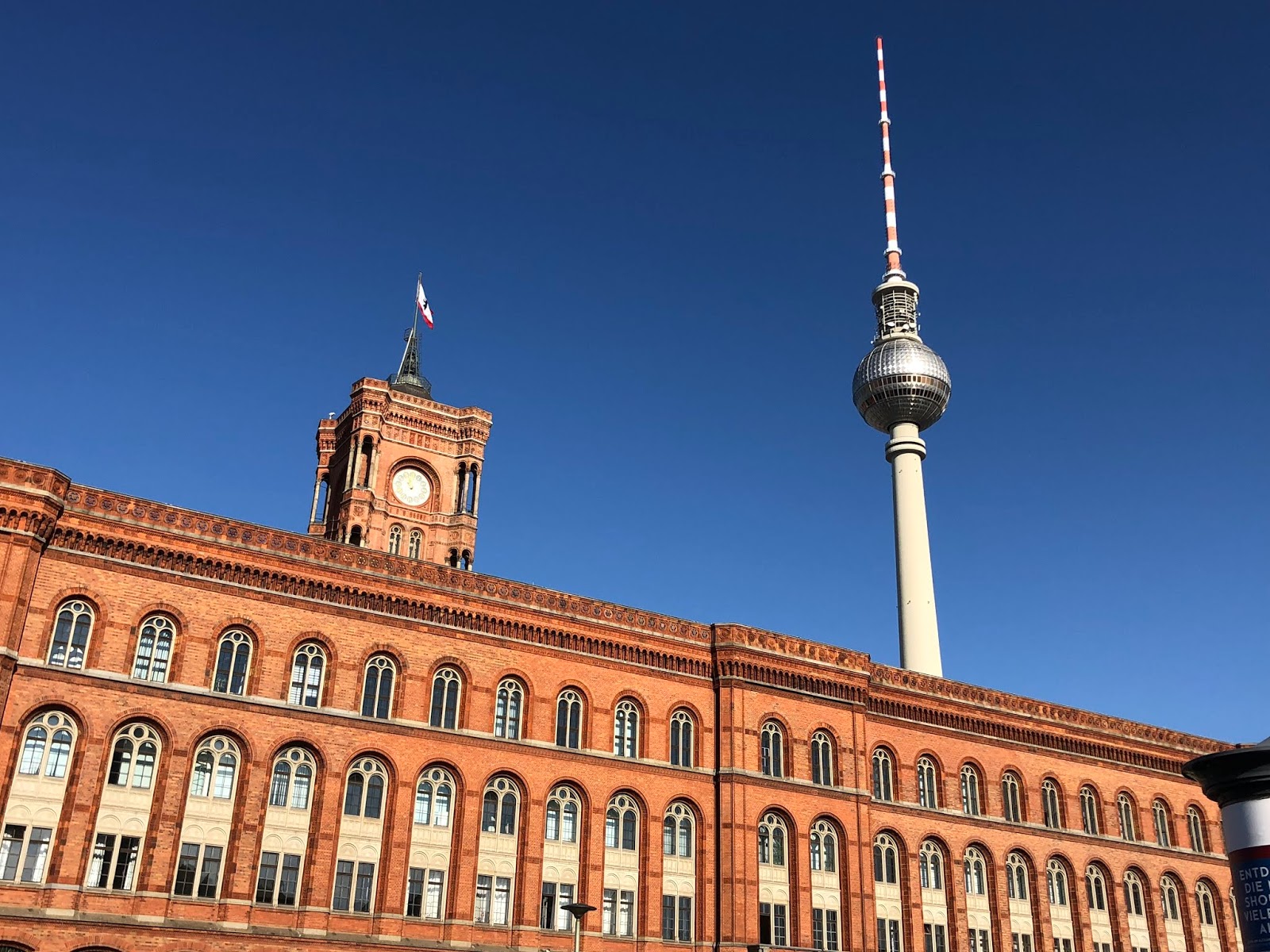
Our first day in Berlin began at the Rotes Rathaus or Red City Hall.  This Red City Hall is the headquarters for the Berlin government and mayor.  The building was damaged during World War II, but has been restored and has housed the city government and mayor since the late 1940's.

While at the Red City Hall we learned some general information about Germany and had two presentations: one from the National Educational Administration and one from the Berlin Senate Department of Education.  Here we learned that Germany is made up of 16 federal states, three of which are "city states"-Berlin, Hamburg, and Bremen.  Germany has 82.7 million people and 3.7 million of them live in Berlin.  In Germany 46% of kids attend nursery school.

The German school system is generally a tiered and tracked system.  All students start with grundschule, or primary school, through 6th grade.  Then, students may track to a gymnasium secondary school, the college prep route, or a integrierte sekundarshule, which is an integrated secondary school, more of a vocational track.  They attend these secondary schools for four years until grade ten at which point students in the gymnasium track continue for two years to the Abitur which is the college entrance exam.  Students in the vocational track could continue with vocational training and then enter the workforce or take the abitur after an additional year.  Ultimately, we learned that the German system is much more fluid than it used to be with some students taking more school in the vocational track and then sitting for the Abitur, while others pursue the gymnasium track and choose to attend vocational school.  The good news is that failing a test doesn't prevent a student from accessing a track, it just means it may take a bit longer.  There are fifteen different frameworks for schools in Germany so it took much longer than just this presentation for us to understand the intricacies.

The Abitur is a high stakes college entrance exam.  There is pressure from the business community to keep the abitur prestigious.  The exam is given to all students on the same day at the same time each year.  Subjects tested include math, German, two second languages, and more.


The National Educational Administration shared information about how their schools are organized and evaluated.  Each school is measured against their own data rather than measured against other schools.  Schools must develop and publish their goals and teachers are evaluated every five years by their principal (headmaster).  Teachers are supported in coaching programs.  Each school has the same base budget but the funding is thought of more in terms of what services each school needs to provide their students rather than budgetary bottom lines.


Here are some interesting differences between schools in Germany and schools in the U.S.
  • In Germany teachers are hired by the state and assigned to a school rather than be hired by individual schools.
  • All German school administrators still teach at least one class.
  • There are no outside substitutes so teachers must cover each other's classes.
  • Homeschool is not an option.
  • Attendance is taken very seriously and there are state laws restricting the number of days a parent can take their student out of school for any reason.
Here are some interesting similarities:
  • The German system is becoming more and more focused on competency based education.
  • They also focus on STEM fields, but in Germany it's called "MINT" which stands for math, infographics, natural sciences, and technology.
  • Special Ed students are taught in an inclusive system and are integrated into regular classes as often as possible.
Overview of the German school system
Germany, and Berlin especially, is a multicultural country and there is an expectation of acceptance of cultural diversity.  In Berlin, 38% of all school students have a migrant background and 18% of their citizens have dual citizenship or a foreign nationality.  In order to build success for migrants, German schools offer "Welcome classes" for migrants which teach in their heritage language as well as teach German language and other skills.  Some schools offer courses for parents as well, especially for mothers of students in nursery school.

Our group at the Federal Foreign office.
We also learned about the European model of instruction which is a dual language immersion program.  In these schools, half of the students are native German speakers and half of the students have a different mother tongue. In Berlin there are 9 combinations of languages and 17 primary schools and 15 secondary schools taught in this way.  The teachers are native speakers in both languages and different subjects are taught in each language throughout the day.  In addition to the bi-lingual skills, one of the key goals of this program is cultural awareness of one's own culture as well as other cultures.

After these insightful presentations, we walked to the Federal Foreign Office where we learned about Germany's efforts to collaborate with other countries.  We also learned about the efforts that are made to promote education internationally and build cross-cultural understanding around the world.

My amazing dessert at La Banca restaurant in the Hotel de Rome
As our morning came to a close we had an outstanding four course lunch at the Hotel de Rome and were able to visit the rooftop terrace with beautiful views of Berlin.

Wednesday, October 31, 2018

Sonntag-10/14/18-Bright Lights, Bigger City-Cee Lo Green


I'm off on a new adventure on a trip sponsored by the Goethe Institute and Germany's Central Agency for Schools Abroad.  Our journey began on Saturday with an orientation at the Goethe Institute's New York office.  We learned a bit of German, discussed cultural perceptions and cultural differences to be aware of when traveling to Germany.  Some differences we learned are that Germans are known for being more direct than Americans and don't always require as much personal space.  Also, Germans prefer more in depth conversations to small talk and enjoy talking about politics.  During our orientation, we also learned about Germany's outreach efforts and agencies worldwide.  The Goethe Institute is a German cultural association which promotes the study of German and encourages international relations.  There are 159 institutes in 98 different countries.  I was so impressed by that and wished the U.S. made similar outreach efforts to connect with countries globally.

Before we knew it, we were off to the airport arriving in Berlin on Sunday morning.  We arrived in Berlin to unusually warm weather and we immediately off for our first cultural activity.  We visited the Berlin Wall Memorial.  For those born after 1985, the Berlin Wall was built in 1961 during the Cold War.  Berlin was in East Germany, but three-quarters of the city (West Berlin) was occupied by France, the UK and the US.  The wall was put up overnight in order to contain citizens and prevent people from escaping East Germany through West Berlin.  The Wall remained a symbol of the Iron Curtain until East Germany announced they would no longer restrict movement across the border in November of 1989.  The Wall came down shortly after and the memorial started in 1990 as a way to commemorate the history and move forward with reconciliation.  One thing that impressed me most about Germany was its efforts to reflect on its history and learn from its past.  Often in the U.S. we choose to gloss over the more negative aspects of our country's story.  However, following the German example of reflecting on these events allows the country to acknowledge and move forward in a new, more positive direction.

Our dinner view
The Berlin Wall Memorial includes a 200 foot section of the Wall as it stood with the wall, electric fence, no man's land and guard tower.  Throughout the 1.5 km there are steel rods showing where the wall used to be.  When you look at them from an angle, they appear to be a solid wall but one can easily walk through them, symbolizing the freedom with which Beliners now move about the city.

Prost!
After a guided tour, we had dinner in a lovely European courtyard and were on our way to see the final night of Berlin's "Festival of Lights".  During this ten day event, Berlin's historic buildings are lit up each night in a beautiful and artistic light show.  Despite our jet-lag and the late hour, this was an amazing event and I would highly recommend it if you're able to visit Berlin during the festival.


Festival of Lights


Brandenburg Gate

Wednesday, February 15, 2017

Shadow of the Day-Linkin Park

First Period-World Geography
Yesterday I took part in the Shadow a Student Challenge and followed a Bozeman High freshman through his day to learn what BHS is like from the student perspective.


Second Period-English I


Translating and Solving Equations with Percents
I had a really insightful day and learned a lot but here are a few quick takeaways:

1.       1. The teacher’s enthusiasm can make or break a class.

        2.  I was surprised at how few phones I saw all day.  The overwhelming majority of kids kept their phones away during class.

3.       3. Five minutes is not nearly long enough to get where you need to go and also use the restroom, get a drink, and/or stop at your locker.

4.       4. There’s a lot of sitting in a student’s day.

5.       


5. It’s a weird feeling to not control your own time.

6.     Student learning does not often feel connected to the real world.  While I was never bored and felt the teachers were using good instructional strategies, when I asked the student I was shadowing what he thought the most important thing for me to learn about his day was, he answered, “It’s boring.”

7.     Even when teachers provide opportunities for movement, the chance to breathe and stretch during a choir warm up is incredibly invigorating.

8.     I didn’t find myself watching the clock at all the entire day.

9.     We don’t give students enough opportunities to explore or talk about things they really care about.  During one period a week my student works with a mentor and his entire demeanor changed, his face literally lit up, when he had the opportunity to talk about skiing, cars, and his dogs.


10. There’s a lot of math in science.
More math in science-force, acceleration and mass

Tuesday, November 15, 2016

(What's So Funny 'Bout) Peace, Love, and Understanding-Elvis Costello

It has taken me about  a week to begin to fully process the election results.  The social studies teacher in me has processed in historical quotes, but what I can’t get out of my mind is that this election must be a call to action for good.

As I watched the election results roll in last Tuesday, I felt like I was living in Germany in the 1930’s with a demagogue assuming power over people controlled by the media.  Joseph Goebbels, one of Hitler’s key advisors, once said, “A lie told one thousand times becomes a truth.” In today’s modern era of media, this is true more than ever.  And, Tuesday night, as I read all of my friends’ Facebook posts about moving out of the country, I felt more than ever that we have become a society immobilized by fear.  This reminded me of another quote from Nazi Germany by Herman Goering, “The people can always be brought to the bidding of the leaders…tell them they are being attacked, and denounce the peacemakers for lack of patriotism and exposing the country to danger.”  Our citizens are being fed a line of fear whether we are told we are being attacked by Muslim extremists, political correctness at home, unfair economic conditions, etc.

While our media outlets and social media addictions are continuing to divide and separate us, I was reminded of Martin Luther King Junior’s quote, “Darkness cannot drive out darkness; only light can do that.  Hate cannot drive out hate; only love can do that.”  Continuing to point out differences only serves to continue to divide us.  We cannot allow ourselves to become susceptible to these manipulation tactics.  We must act.  Franklin Roosevelt stated, “Democracy cannot succeed unless those who express their choice are prepared to choose wisely.  The real safeguard of democracy, therefore, is education.”  We must educate ourselves, and others, to reach a greater understanding among all Americans.

Whether you are happy or sad about the election, here are some things you can do to better educate yourself and better serve our country.
  •  Stop continuing to talk about the “other side” and try to better understand people who believe differently than you.
  • Stop falling prey to misinformation on the Internet.
  • Be a better citizen in your community-volunteer, join a local board, attend city meetings, find out what is happening in your community and join in.
  • Actively seek connections with people who are not like you.
  • Learn about the Constitution, your rights, our system of government-why it was set up this way and how it has evolved over time.
  • Donate to causes that are important to you.


I believe that by doing these things the citizens can regain control and get back to the ideals expressed by Abraham Lincoln that this country is “of the people, for the people and by the people.”

Saturday, October 1, 2016

Don't Let It End-Styx

It's hard to believe our final day came so quickly!  We didn't fly out of Uganda until 11:30 at night but, with unreliable roads and traffic, it can take 2-3 (even more during high traffic periods) hours to travel the 29 miles from Mukono to Entebbe.  That means we left fairly early in the morning to avoid rush hour.

After our drive we arrived in Entebbe with some time to visit the zoo.  We had heard there was a Behind the Scenes zoo option so we signed up for that and it was worth every penny!  Basically we were able to go into every exhibit and interact with the animals.  We started with the giant python-he did not seem happy to see us and was wrapped tightly around my leg by the time our picture was over.  Next we headed to the aviary to visit a shoebill stork.  This bird has been around since the prehistoric times and was fascinating to watch.  They make a chattering sound (much like my nervous dog who chatters his teeth) with their beaks and have interesting mannerisms when they are threatened or approached.  We were able to get close enough to pet him which was a cool experience.  We then headed over to the big cats and visited lions and a leopard.  Our guide fed them some meat through the bars and we were able to see them up close.  We were toured around in the back of a pick up and our next stop was to drive right into the rhino area.  We drove right next to them and although they didn't eat the grass we offered, we were able to pet their muddy backs.


From the rhinos, we next stopped at the hospital where two cheetahs were being rehabilitated.  We were able to enter the area one at a time and pet the cheetahs-it was an incredible experience!  The whole time I was in the enclosure with the cheetahs, I kept thinking that this experience wouldn't be possible in the U.S. no matter how many waivers were signed.  Our next stop was to pick up some food at the barn and then we visited the chimpanzee island, the Serengeti exhibit where we fed giraffe (their heads are as big as my torso!) and eland, then the elephant pen where we were able to feed a one year old elephant.  We stopped and enjoyed the monkeys on our way out.

After a delightful afternoon we picked up our bags, had lunch with some family friends who live in Uganda with the state department and boarded our plane for Amsterdam.