Sunday, June 19, 2016

Go Getta-Young Jeezy

Thursday, June 16:


Pastor Francis and his "assistants"
For the next week, our group will break up into smaller groups of 3-5 to work on immersion projects with local partner organizations.  There is a group working with special needs kids, a group working with a women’s organization in a community library, and my group working with a local community organizer named Pastor Francis.


Pastor Francis is a Ugandan mover and shaker, but his passion lies with with the people in the slums of Lugazi and he lives and works there on various projects.  He hosts a school for children of the slums in grades preK-Primary 6.  They are not a sanctioned boarding school but are experimenting with boarding some students whose parents cannot take care of them due to work or health, so about twelve students are living at the school

In the evenings, he offers a wide range of classes that support community development goals as part of what he calls the Canaan School of Project Management and Development.  One of his more popular classes is project management but he also offers counseling classes, HIV prevention, nutrition and hygiene, family and marriage counseling, and many more.

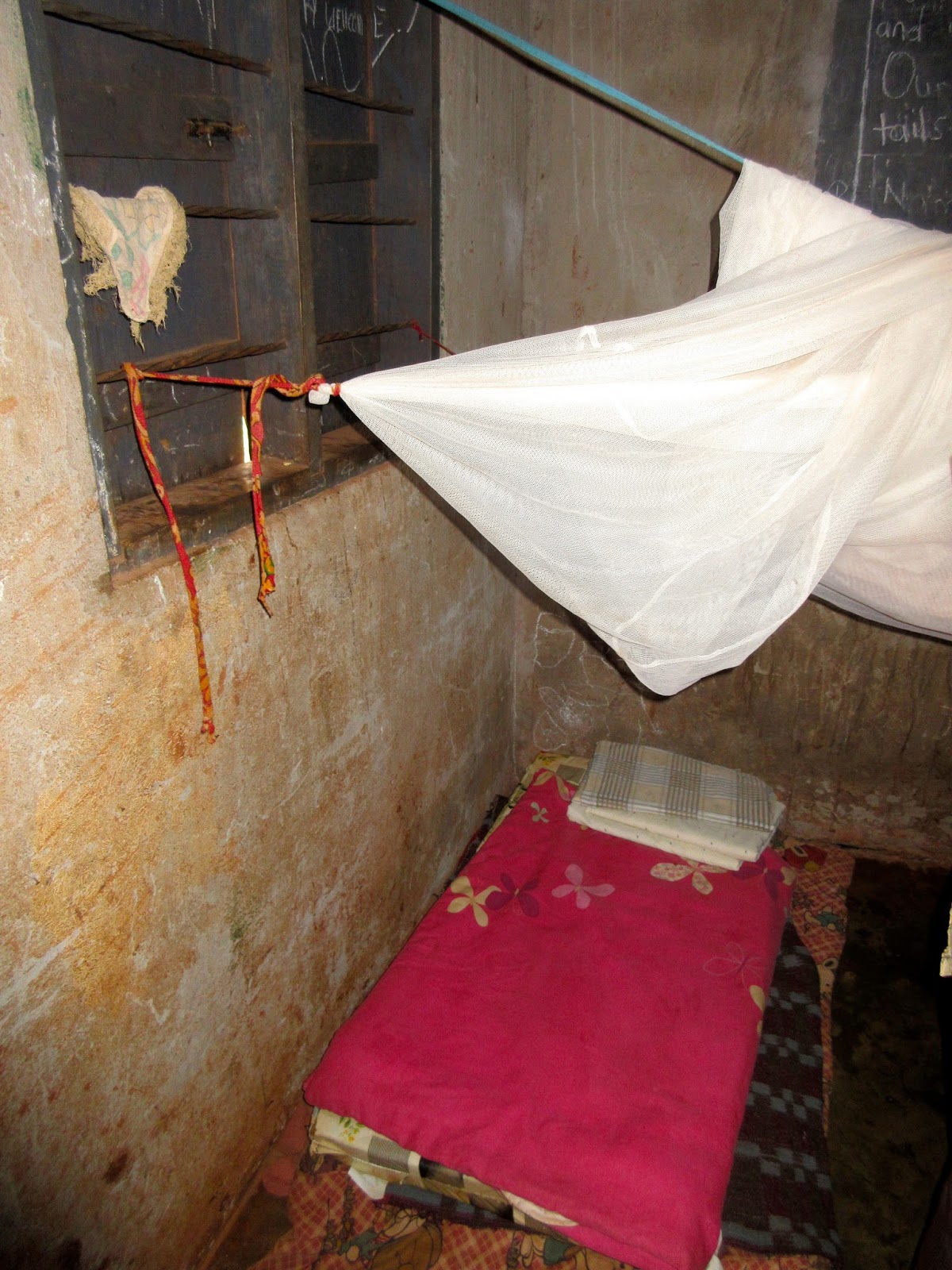
The conditions of the school and boarding rooms were pretty striking.  Four students stay in one room and eight small children stay in another with one older student and a care taker. 
There was a classroom for each grade level P1-P6.  The class sizes ranged from 10-25.  The school recently lost about 25% of its students because two other local schools got more sponsorships and were able to allow more students to attend on scholarship.  The school systems here are very interesting and hard to figure out.  There are public and private schools and all schools cost something, although the price ranges vary greatly.  Pastor Francis told us it costs about 150,000 shillings (about $50) for a student for a term.  However, he only charges parents what they can pay and tries to get sponsorships and donations to cover the rest of the costs.  Some parents pay as little as 20,000 shillings (about $6.50).

There are three terms each year that last about 2-3 months each and they have a two month break in December and January.

Most of the schools teach in a pretty traditional way with students copying down notes from the board.  Pastor Francis encourages more interactive teaching styles, which is pretty unusual for the area.  However, there is still a lot of copying a daily exercise from the board. 

Although the national language Is English, Lugandan is still the unofficial and most commonly spoken language.  It is prestigious to send your students to a school where all instruction is in English.  However, what we have observed is that often students just copy what is written in English without really understanding what it means. 

Pastor Francis asked us to observe some classes to get a sense of the teaching style so we could provide some instructional tips.  It was fun to see the students’ enthusiasm as every student in class would raise their hand to answer a question.  Our group divided up and each of us visited different classes.  I observed the pre-school and P1 classes and listened to the students sing some songs and work on their numbers and counting.    Each student has an exercise book in which they write down the daily lesson.  The teacher corrects these at night and sometimes writes in each book (by hand for each student!) a kind of work sheet type thing for students to complete.  As students are working there is typically one pen or pencil for every three students.  In the pre-school class, the students were so distracted by having a white person in their class that they just swarmed me and the teacher could hardly get anything accomplished.


At one o’clock it was lunch time and we played with many of the students on the playground before having a lunch that Pastor Francis’ wife had made for us.  We had cooked bananas with ground nut stew, pumpkin, a green vegetable called bugga, and pineapple.  While we were having lunch, Pastor Francis told Michael that “real men finish food.” And served up an entire second plate of food-it was pretty funny.


We made plans for the following day-when Pastor Francis wanted us to teach the class.  Then we toured more of the grounds.  Pastor Francis has been working on a vision to mix compostable garbage into the soil to create more fertile garden areas and then grow vegetables for the community.   He had a plot of pumpkins right now and was hoping we could help sort garbage and bury compost in another area the following day.


The rest of our group arrived and quickly toured the facility.  Then we all headed off to visit some of the microenterprises Pastor Francis has sponsored.  We first visited a man who grinds millet.  He sells millet at a roadside shop and has also expanded to sell to some local grocery stores.  What often happens in Uganda is that one person starts a business that is successful so others follow suit and set up the exact same business in hopes of making money as well when they are, in fact, creating competition for each other.  Pastor Francis tries to teach his project development students to come up with new ideas that meet a community need in order to create their own niche which this millet grinder has done.

buying some millet


To get to the next microenterprise, we walked through the slums of Lugazi.  As we walked, every child came running and waving shouting “Muzungu”.  Many just wanted to touch our skin and many would grab a hand or an arm and walk along with us.  It was like a processional of white people and an interesting experience.


The final microenterprise we stopped at was a husband and wife who are bagging yogurt for sale.  They began as a small roadside shop and are now selling from a location on the main road where they also wholesale to grocery stores and other shops and also sell juice and drinkable water in small bags.


Products for sale at a roadside shop

We loaded into our van and drove back to Mukono where we had dinner and a debriefing meeting.  It was so interesting to hear about all of the different projects people are working on during our stay.


Saturday, June 18, 2016

Rains Down in Africa-Toto

I woke up in the middle of the night to an intense rain storm.  It was downpouring so loudly I could hardly fall back asleep.  I just not believe how hard it was raining-although I guess I shouldn’t be surprised since we were in a rain forest.  I got a little nervous because we had driven through a lot of road construction that was now most likely a mud pit.

We took off a bit later than expected due to the weather but once our luggage was all covered with a tarp and tied down in the back of the pick up, we were off.  The road was pretty muddy for the first hour and a half.  There were a few times I was afraid we might not make it up a hill or might get stuck but miraculously we made it to a paved road with only a few spin outs.


Trying some fried crickets as a snack
Along the way we stopped a few times for snacks and gas.  It’s always so interesting to watch the countryside.  One thing I find really interesting here is all of the political campaign ads posted around.  The government is known for being pretty corrupt; although, the president did recently win re-election a few months ago.


I always like taking pictures of shoe stores in other countries.
 
Houses with an "X" will be demolished because they are too close to the road


After a pretty grueling 9 and a half hour journey-and serious traffic jam around Kampala, we finally arrived in Mukono where we’ll be staying for the next week.  During our time here we’re working with local organizations and schools and we joined our Ugandan partners for an introductory dinner before heading off to bed.


Friday, June 17, 2016

Welcome to the Jungle-Guns N' Roses

Today I had one of the most amazing experiences of my entire life.  We were able to sleep in a bit and didn’t need to report for breakfast until almost eight o’clock (that was nice, but not the most amazing thing).  After our usual breakfast of fresh fruit, juices, and cheese omelets, we were back in the fifteen passenger van driving to Kibale National Park.


We weren’t on the road long when we stopped for a photo op at the Equator.  An interesting fact-water drains in clockwise and counter clockwise directions on each side of the Equator and if you walk just twenty feet in either direction, you can see the difference.  Also important to note that if you’re traveling right around the Equator, the daylight and darkness are almost equal most of the year.  In Uganda it gets light around 6:30am and dark around 6:30pm.

We packed back in and, after a short distance, turned off the main road onto a “short cut”.  We spent the better part of three hours on this windy, dusty road.  At times the dust was so thick it had covered all of the plants along the side of the road in a layer of burnt orange.  The countryside of Uganda is beautiful with rolling hills of banana trees, tea, and other crops.   However, I find it even more interesting to watch as we pass through little towns and villages.  I love watching the people-kids walking to school in their school uniforms, groups of men on boda bodas (motorcycle taxis) waiting to give someone a ride, bicycle repair shops, fruit markets, men doing landscape maintenance with machetes, etc.
 
We saw many, many bicycles overburdened with bananas being pushed up and down the road and eventually came to a huge banana market where huge bunches of green bananas were being loaded to take to markets.  We also passed through a radish market that had so many thousands of radishes you could smell them for blocks.


We finally made it to the Office of the Ugandan Wildlife Authority where we picked up our passes for chimp trekking.   We had another hour or so to drive and now the dirt road was under construction.  It was interesting to see how the road construction worked as it appeared they were trying to widen the road for several miles.  There was fresh gravel and dirt being packed down with steam rollers.  It was the smoothest part of our journey!  In Uganda they have small speed bumps as you enter and leave every city, not to mention many potholes, so it can get pretty bumpy in the back of the van!

We arrived at our new lodge and after a quick lunch were on our way to Kibale National Forest for chimp trekking.  We had a brief introduction where they discussed the animals of Kibale Forest.  The park is known for chimpanzees but also has baboons and seven other types of monkeys.  There are larger mammals like elephants and forest hogs, and over 200 different types of butterflies!  We received information about how to behave around the chimps-we had to be quiet, we couldn’t go within a certain distance, and if one charged us we were just supposed to stay still unless it’s carrying a stick or log in which case we’re supposed to step aside. (Seriously, those were our instructions…) 


We drove a few kilometers to a backroad into the park and then began trekking in small groups of five, each with an armed escort.  Within a quarter mile we came upon two female chimps high up in the trees.  I didn’t understand why our guide didn’t stop to let us take pictures because I thought we couldn’t get within 80 meters of the chimps. However, a minute later I learned that she meant EIGHT meters as we came upon three chimps sitting around and we walked right up until they were right in front of us!  This was the beginning of an amazing two hours as we explored the forest and observed chimpanzees. 
Males having a nap, they like to sleep upside down apparently

Kibale Forest is home to 450 chimpanzees and one family group, of about 120, has been habituated to humans.  They do treks to see the chimps twice a day for informational purposes.  We learned that the males and females hang out in separate groups and that the males allow humans to approach them closer.  The females are more shy because they are protecting their young.  We were able to get quite close (within 8 meters to be honest) to several groups of males.  While we didn’t get too close to females, we did see quite a few, many with babies, and many young chimps playing as well.

Just eating a few ticks as a snack while grooming a buddy
Chimps can live to be around 55-60 years old.   Most of the males we saw were in their early twenties; although, we did see one of the older males who was in his late 40’s.  Baby chimps will nurse and nest with their mothers for the first three years of their lives.  Then their mothers wean them until they are about five.  After that, they have to make their own nest each night.  It takes a chimp about 3-5 minutes to make a nest and they make a new one each night because they move throughout the forest.  One of the coolest and craziest things was hearing the chimps call to each other in the forest.

When we emerged from the forest we found an entire family of baboons snacking along the road and enjoyed watching them as we walked back to the main road.  Several of us walked down the main road towards our camp as our driver took the guards back to their headquarters.